


By Mugula Dan
18 Nov 2026
Justice and Constitutional Affairs Minister Norbert Mao has cautioned against proposals attributed to Veteran Journalist and political commentator Andrew Mwenda on the use of unconventional methods to achieve Uganda’s socio-economic transformation, insisting that any government action must comply with the law.
Mao said there could be different opinions on how Uganda should achieve socio-economic transformation, but argued that unlawful detention, torture and other actions outside established legal procedures cannot be justified as alternatives to the rule of law.
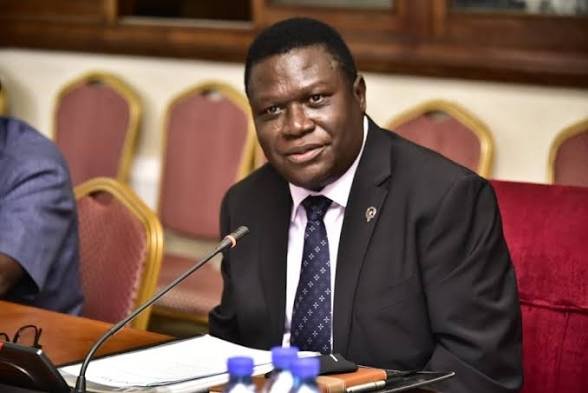
“If Andrew Mwenda believes that training people on the streets and locking them up in the basement is the way to get Uganda to achieve socio-economic transformation, that is his view. There should be other views to contend with that view. But there is no compromise on obeying the law,” Mao said.
The minister made the remarks while addressing journalists at the Uganda Media Centre, where he also discussed human rights, unlawful detention, habeas corpus, professional ethics among lawyers and preparations for the 2026 National Justice Week.
Mao said governments that seek to suspend certain laws in pursuit of national transformation must first follow constitutional procedures, including declaring a state of emergency where legally justified.
“As of now, we must abide by the law,” he said, adding that his responsibility as Minister of Justice was to raise concerns about violations while leaving enforcement and disciplinary action to the relevant authorities.
He compared his role to that of a linesman in a football match, explaining that he could raise a flag to indicate a violation but did not have the authority to issue red or yellow cards.
He said the President, whom he described as the referee, had the responsibility to respond to such concerns and ensure that the rules were enforced.
On allegations of abductions and unlawful detention, Mao said every person arrested must be held in a legally recognised and gazetted place of detention.
He emphasised that security agencies and other authorities cannot arbitrarily detain individuals in undisclosed locations, adding that so-called safe houses must also be known and operate within the law.
Mao said torture chambers and secret detention facilities were illegal, warning that holding suspects in undisclosed locations undermines public confidence in the justice system.
He also defended the importance of habeas corpus, explaining that the legal remedy exists to protect individuals against unlawful detention and to compel authorities to produce detained persons before court.
According to Mao, applicants seeking habeas corpus orders are required to demonstrate that a person has been arrested or is missing and identify the authority believed to be responsible for the detention.
He said courts do not need to conduct a fresh criminal trial before issuing such an order once they are satisfied that a person is missing or unlawfully detained.
Mao clarified that obtaining a habeas corpus order does not automatically mean that the affected person is innocent of any alleged offence.
Instead, he said, the order requires authorities to produce the individual before court and explain the legal basis for the arrest and detention.
He warned that unexplained disappearances create fear among citizens and weaken confidence in the ability of the law to protect them.
The minister also called for an end to personal attacks and political divisions within the legal profession, saying disagreements should be addressed through dialogue and established institutional procedures.
He said he had visited the headquarters of the Uganda Law Society and engaged its members, expressing his desire to see an institution that serves all lawyers impartially and without political bias.
Mao further challenged lawyers to uphold professional ethics, particularly in handling clients’ money and maintaining transparency in legal fees and other expenses.
He explained that lawyers are required to maintain separate accounts for their professional fees and money received from clients for expenses incurred while handling cases.
He also criticised lawyers who allegedly exploit clients by demanding excessive payments without proper accountability, as well as those accused of bribing court officials or interfering with court records.
Mao said the Law Council had a responsibility to discipline lawyers who engage in professional misconduct, including those accused of defrauding members of the public.
The remarks came as Mao announced that the annual National Justice Week 2026 would take place from November 23 to December 4, under the theme, “Advancing Integrated People-Centred Justice, Law and Order Delivery System for Social and Economic Transformation.”
The event will provide a platform for public engagement, accountability and improved access to justice, bringing together institutions under the Justice, Law and Order Sector (JLOS), development partners, civil society organisations and other stakeholders.
Mao said justice should not be measured merely by the existence of laws and constitutional provisions but by the actual experiences of citizens seeking protection and access to legal services.
He identified land disputes, inheritance conflicts, unfair treatment of employees, delayed trials, contract enforcement and the exploitation of vulnerable people as some of the everyday challenges that require an effective justice system.
He argued that justice is also an economic necessity because reliable courts and effective enforcement of contracts protect property rights, encourage investment, promote fair competition and reduce the cost of doing business.
The minister said the Justice, Law and Order Sector was marking 25 years of cooperation among institutions, citing alternative dispute resolution, mobile courts and improved coordination among justice institutions as some of the achievements.
However, he acknowledged that case backlog, the high cost of legal services and inadequate access to justice in underserved communities remained major challenges.
Mao said this year’s celebrations would also recognise individuals and institutions that have made outstanding contributions to justice and the rule of law, with the JLOS Recognition Awards scheduled for December 3.
He added that the government would prioritise legal aid, community justice, mediation and public legal education to ensure that vulnerable citizens understand and can exercise their rights.
On addressing case backlog, Mao highlighted plea bargaining as one of the approaches being used to resolve cases more efficiently while taking into account the interests of victims and their families.
He cited the murder case involving businessman Matthew Kanyamunyu as an example of plea bargaining, explaining that the process involved engagement with the victim’s family, an admission of guilt and a subsequent court decision.
Mao said the justice system should not be designed merely to keep people in prison but should also promote accountability, reconciliation and social harmony.
He said government was also working to strengthen judicial capacity, including increasing the number of High Court judges following parliamentary approval of relevant measures.
Mao maintained that access to justice should not depend on wealth, social status or proximity to court facilities, saying every Ugandan, including those in remote communities, deserved equal protection under the law.